

Welcome to the February edition of THE TAKEOFF.
After the wild weather January threw our way, it feels like everyone is ready for a fresh start. As projects ramp up after the new year, many owners and design teams are balancing early design momentum with real-world cost pressures.
We’re seeing more conversations around phasing, scope prioritization, and how to keep projects flexible without losing clarity. This month, we’re sharing insights from what our team sees in the field, where early decisions have the biggest impact and how thoughtful coordination can help teams stay aligned on budget, schedule, and long-term value.
We’re glad to share what we’re seeing and hope it helps you approach your projects with a little more confidence and a lot less guesswork.
- Brandon & Sarah
February’s Quick Take
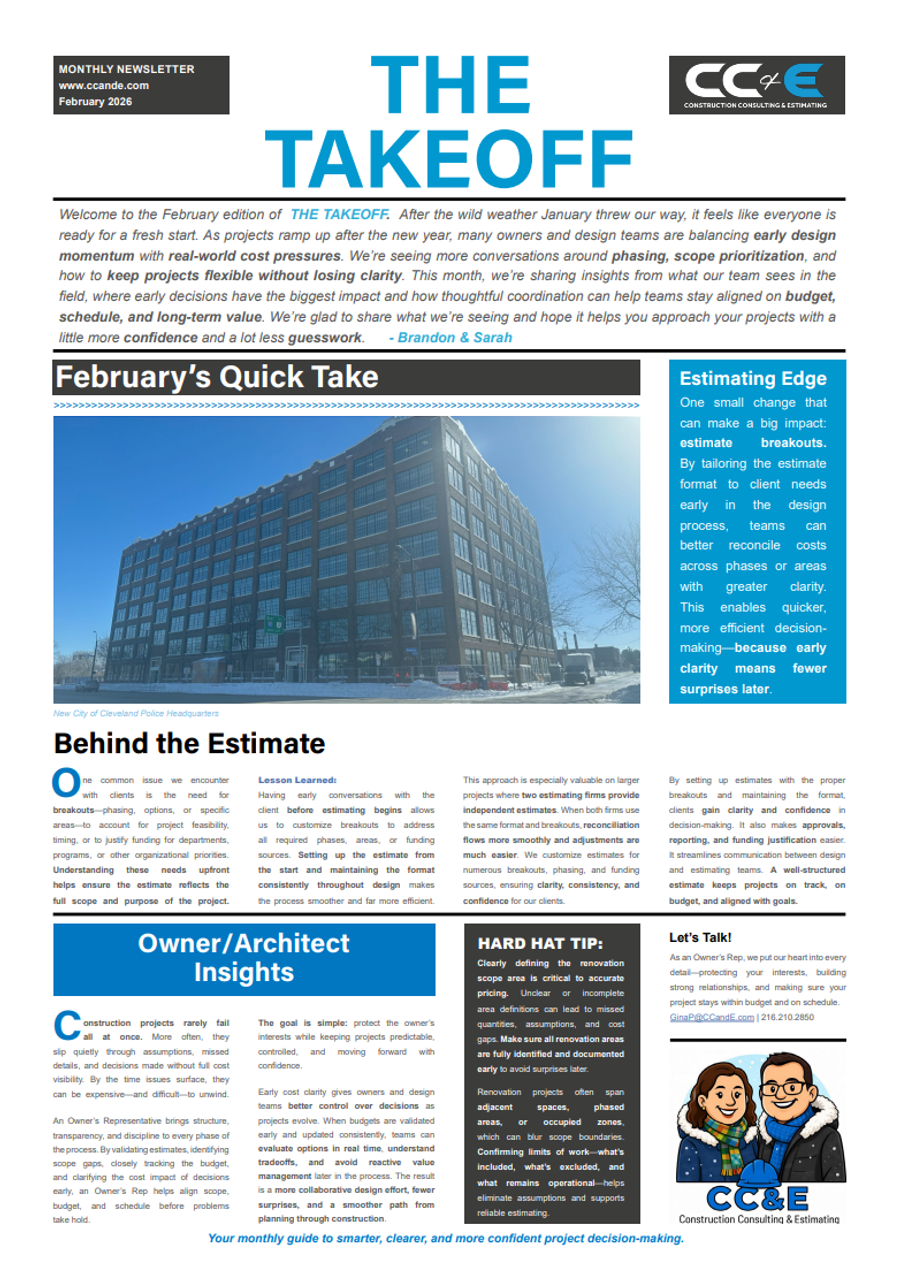
New City of Cleveland Police Headquarters
One small change that can make a big impact: estimate breakouts.
By tailoring the estimate format to client needs early in the design process, teams can better reconcile costs across phases or areas with greater clarity.
This enables quicker, more efficient decision-making because early clarity means fewer surprises later.
Behind the Estimate
One common issue we encounter with clients is the need for breakouts, including phasing, options, or specific areas, to account for project feasibility, timing, or to justify funding for departments, programs, or other organizational priorities.
Understanding these needs upfront helps ensure the estimate reflects the full scope and purpose of the project.
Having early conversations with the client before estimating begins allows us to customize breakouts to address all required phases, areas, or funding sources.
Setting up the estimate from the start and maintaining the format consistently throughout design makes the process smoother and far more efficient.
This approach is especially valuable on larger projects where two estimating firms provide independent estimates.
When both firms use the same format and breakouts, reconciliation flows more smoothly and adjustments are much easier.
We customize estimates for numerous breakouts, phasing, and funding sources, ensuring clarity, consistency, and confidence for our clients.
By setting up estimates with the proper breakouts and maintaining the format, clients gain clarity and confidence in decision-making.
It also makes approvals, reporting, and funding justification easier. It streamlines communication between design and estimating teams.
A well-structured estimate keeps projects on track, on budget, and aligned with goals.
Owner/Architect Insights
This section highlights how owner’s rep support helps keep projects organized, transparent, and aligned before small issues become bigger project challenges.
Why Projects Slip
Construction projects rarely fail all at once.
More often, they slip quietly through assumptions, missed details, and decisions made without full cost visibility.
By the time issues surface, they can be expensive and difficult to unwind.
How an Owner’s Rep Helps
An Owner’s Representative brings structure, transparency, and discipline to every phase of the process.
By validating estimates, identifying scope gaps, closely tracking the budget, and clarifying the cost impact of decisions early, an Owner’s Rep helps align scope, budget, and schedule before problems take hold.
The Goal
The goal is simple: protect the owner’s interests while keeping projects predictable, controlled, and moving forward with confidence.
Early cost clarity gives owners and design teams better control over decisions as projects evolve.
When budgets are validated early and updated consistently, teams can evaluate options in real time, understand tradeoffs, and avoid reactive value management later in the process.
The result is a more collaborative design effort, fewer surprises, and a smoother path from planning through construction.
Estimating Edge: Estimate Breakouts
One small change that can make a big impact: estimate breakouts.
By tailoring the estimate format to client needs early in the design process, teams can better reconcile costs across phases or areas with greater clarity.
This enables quicker, more efficient decision-making because early clarity means fewer surprises later.
Hard Hat Tip: Renovation Scope Areas
Clearly defining the renovation scope area is critical to accurate pricing.
Unclear or incomplete area definitions can lead to missed quantities, assumptions, and cost gaps.
Make sure all renovation areas are fully identified and documented early to avoid surprises later.
Renovation projects often span adjacent spaces, phased areas, or occupied zones, which can blur scope boundaries.
Confirming limits of work, what’s included, what’s excluded, and what remains operational helps eliminate assumptions and supports reliable estimating.
Let’s Talk
As an Owner’s Rep, we put our heart into every detail, protecting your interests, building strong relationships, and making sure your project stays within budget and on schedule.
Ready to Talk Through Your Project?
CC&E helps owners and architects make confident construction cost, schedule, and scope decisions from the earliest planning stages.