

Hello and welcome to THE TAKEOFF - our new monthly newsletter from the CC&E team.
We’re excited to share insights from our group of owner’s representatives and seasoned estimators who are actively working in the field every day.
Each month, we’ll offer quick, practical advice based on what we’re seeing on real projects, what’s working, what to watch out for, and where teams can gain efficiencies and avoid costly surprises.
Our goal is simple: To help architects, owners, and project teams make more informed decisions and deliver successful projects.
We’re glad you’re here and hope you find THE TAKEOFF valuable.
- Brandon & Sarah
January’s Quick Take
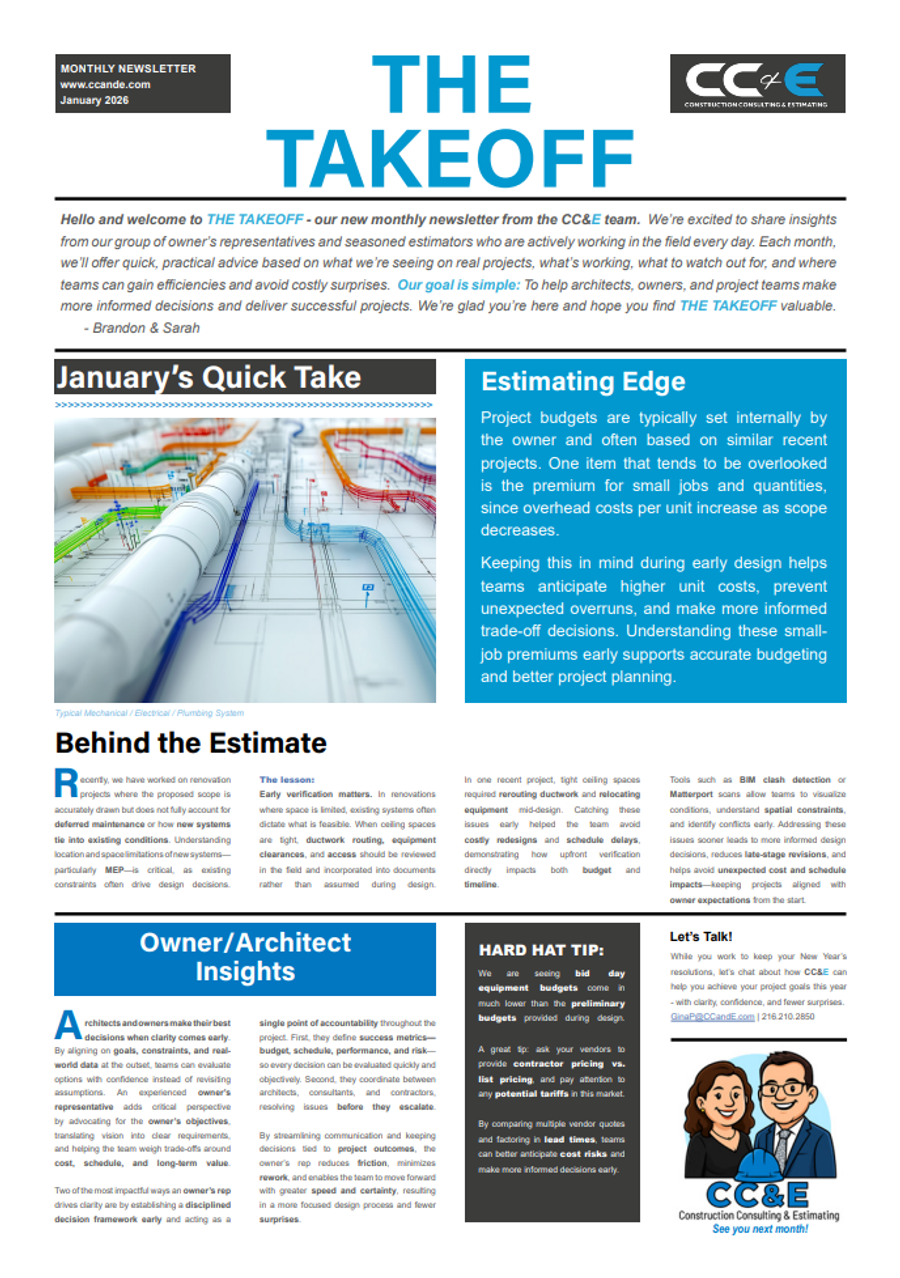
Typical Mechanical / Electrical / Plumbing System
Recently, we have worked on renovation projects where the proposed scope is accurately drawn but does not fully account for deferred maintenance or how new systems tie into existing conditions.
Understanding location and space limitations of new systems, particularly MEP, is critical, as existing constraints often drive design decisions.
Behind the Estimate
Early verification matters.
In renovations where space is limited, existing systems often dictate what is feasible. When ceiling spaces are tight, ductwork routing, equipment clearances, and access should be reviewed in the field and incorporated into documents rather than assumed during design.
In one recent project, tight ceiling spaces required rerouting ductwork and relocating equipment mid-design.
Catching these issues early helped the team avoid costly redesigns and schedule delays, demonstrating how upfront verification directly impacts both budget and timeline.
Tools such as BIM clash detection or Matterport scans allow teams to visualize conditions, understand spatial constraints, and identify conflicts early.
Addressing these issues sooner leads to more informed design decisions, reduces late-stage revisions, and helps avoid unexpected cost and schedule impacts, keeping projects aligned with owner expectations from the start.
Estimating Edge: Small-Job Premiums
Project budgets are typically set internally by the owner and often based on similar recent projects.
One item that tends to be overlooked is the premium for small jobs and quantities, since overhead costs per unit increase as scope decreases.
Keeping this in mind during early design helps teams anticipate higher unit costs, prevent unexpected overruns, and make more informed trade-off decisions.
Understanding these small-job premiums early supports accurate budgeting and better project planning.
Owner/Architect Insights
This section highlights how owner’s rep support helps teams make clearer decisions early, stay aligned around project goals, and reduce costly surprises throughout the process.
Why Early Clarity Matters
Architects and owners make their best decisions when clarity comes early.
By aligning on goals, constraints, and real-world data at the outset, teams can evaluate options with confidence instead of revisiting assumptions.
An experienced owner’s representative adds critical perspective by advocating for the owner’s objectives, translating vision into clear requirements, and helping the team weigh trade-offs around cost, schedule, and long-term value.
How an Owner’s Rep Drives Clarity
Two of the most impactful ways an owner’s rep drives clarity are by establishing a disciplined decision framework early and acting as a single point of accountability throughout the project.
First, they define success metrics, budget, schedule, performance, and risk, so every decision can be evaluated quickly and objectively.
Second, they coordinate between architects, consultants, and contractors, resolving issues before they escalate.
The Result
By streamlining communication and keeping decisions tied to project outcomes, the owner’s rep reduces friction, minimizes rework, and enables the team to move forward with greater speed and certainty.
The result is a more focused design process and fewer surprises.
Hard Hat Tip: Equipment Budgets and Vendor Pricing
We are seeing bid day equipment budgets come in much lower than the preliminary budgets provided during design.
A great tip: ask your vendors to provide contractor pricing vs. list pricing, and pay attention to any potential tariffs in this market.
By comparing multiple vendor quotes and factoring in lead times, teams can better anticipate cost risks and make more informed decisions early.
Let’s Talk
While you work to keep your New Year’s resolutions, let’s chat about how CC&E can help you achieve your project goals this year, with clarity, confidence, and fewer surprises.
Ready to Talk Through Your Project?
CC&E helps owners and architects make confident construction cost, schedule, and scope decisions from the earliest planning stages.