

Welcome to the May edition of THE TAKEOFF.
In the spirit of the season, May the 4th be with you. As summer construction ramps up, projects can feel like they’re moving at lightspeed, with decisions happening faster than ever.
But as any good team knows, speed without clarity can lead to costly course corrections. This month, we take a creative look at the scale of construction, yes, even something as ambitious as a certain intergalactic battle station, while also focusing on what drives successful projects here on Earth: clear communication, defined decision-making, and strong leadership.
With the right guidance, teams stay aligned, reduce friction, and keep projects moving forward with confidence, no matter how complex the mission.
- Brandon & Sarah
May’s Quick Take: Estimating the Impossible, or Is It?
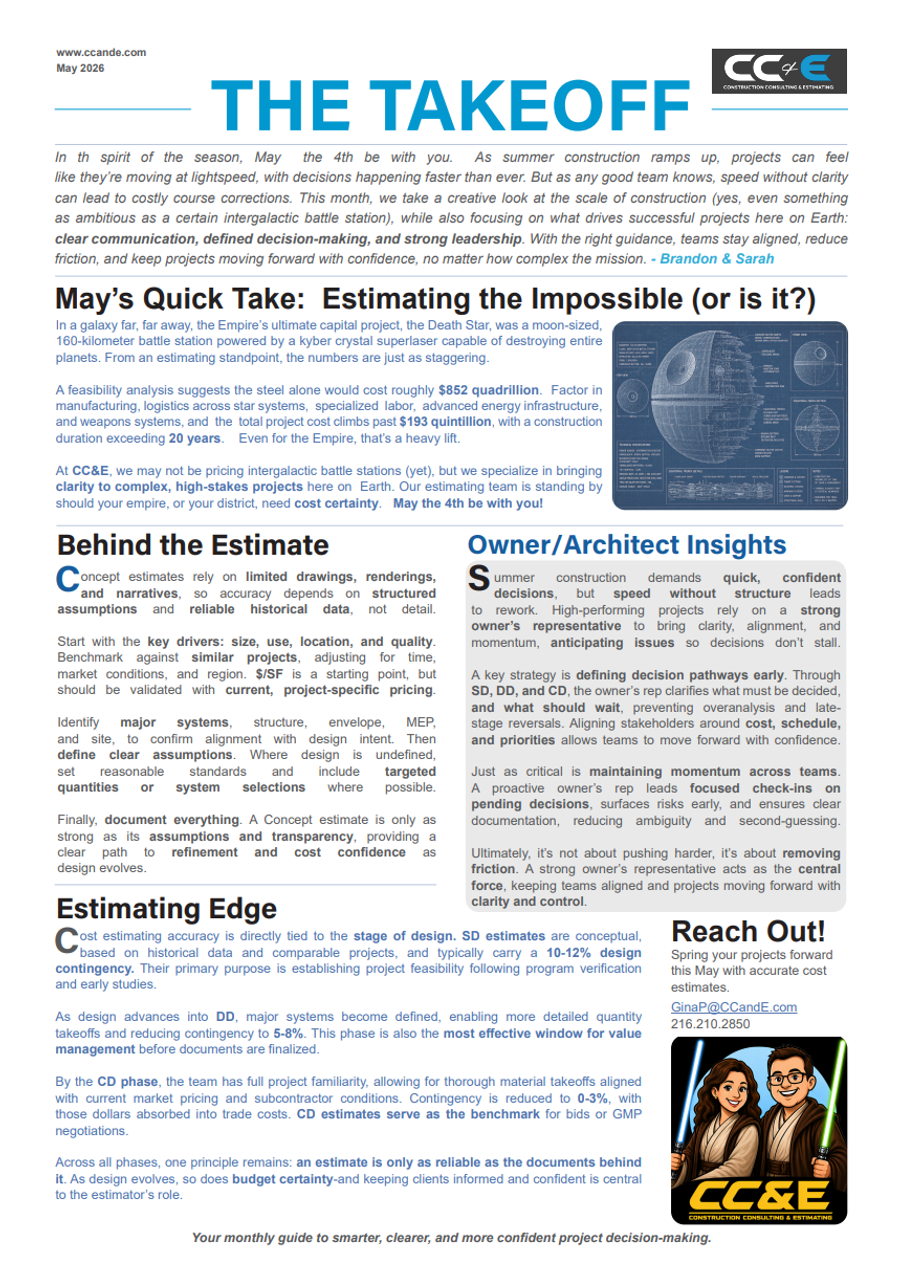
In a galaxy far, far away, the Empire’s ultimate capital project, the Death Star, was a moon-sized, 160-kilometer battle station powered by a kyber crystal superlaser capable of destroying entire planets.
From an estimating standpoint, the numbers are just as staggering.
A feasibility analysis suggests the steel alone would cost roughly $852 quadrillion. Factor in manufacturing, logistics across star systems, specialized labor, advanced energy infrastructure, and weapons systems, and the total project cost climbs past $193 quintillion, with a construction duration exceeding 20 years.
Even for the Empire, that’s a heavy lift.
At CC&E, we may not be pricing intergalactic battle stations yet, but we specialize in bringing clarity to complex, high-stakes projects here on Earth.
Our estimating team is standing by should your empire, or your district, need cost certainty.
May the 4th be with you!
Behind the Estimate
Concept estimates rely on limited drawings, renderings, and narratives, so accuracy depends on structured assumptions and reliable historical data, not detail.
Start with the key drivers: size, use, location, and quality.
Benchmark against similar projects, adjusting for time, market conditions, and region. $/SF is a starting point, but should be validated with current, project-specific pricing.
Identify major systems, structure, envelope, MEP, and site, to confirm alignment with design intent.
Then define clear assumptions. Where design is undefined, set reasonable standards and include targeted quantities or system selections where possible.
Finally, document everything.
A Concept estimate is only as strong as its assumptions and transparency, providing a clear path to refinement and cost confidence as design evolves.
Estimating Edge: Cost Estimating Accuracy by Design Phase
Cost estimating accuracy is directly tied to the stage of design.
SD estimates are conceptual, based on historical data and comparable projects, and typically carry a 10-12% design contingency. Their primary purpose is establishing project feasibility following program verification and early studies.
As design advances into DD, major systems become defined, enabling more detailed quantity takeoffs and reducing contingency to 5-8%.
This phase is also the most effective window for value management before documents are finalized.
By the CD phase, the team has full project familiarity, allowing for thorough material takeoffs aligned with current market pricing and subcontractor conditions.
Contingency is reduced to 0-3%, with those dollars absorbed into trade costs.
CD estimates serve as the benchmark for bids or GMP negotiations.
Across all phases, one principle remains: an estimate is only as reliable as the documents behind it.
As design evolves, so does budget certainty, and keeping clients informed and confident is central to the estimator’s role.
Owner/Architect Insights
This section highlights how strong owner’s rep involvement helps teams make timely decisions, reduce friction, and keep projects moving during fast-paced construction seasons.
Speed Without Structure Leads to Rework
Summer construction demands quick, confident decisions, but speed without structure leads to rework.
High-performing projects rely on a strong owner’s representative to bring clarity, alignment, and momentum, anticipating issues so decisions don’t stall.
Define Decision Pathways Early
A key strategy is defining decision pathways early.
Through SD, DD, and CD, the owner’s rep clarifies what must be decided, and what should wait, preventing overanalysis and late-stage reversals.
Aligning stakeholders around cost, schedule, and priorities allows teams to move forward with confidence.
Maintain Momentum Across Teams
Just as critical is maintaining momentum across teams.
A proactive owner’s rep leads focused check-ins on pending decisions, surfaces risks early, and ensures clear documentation, reducing ambiguity and second-guessing.
Key Takeaway
Ultimately, it’s not about pushing harder, it’s about removing friction.
A strong owner’s representative acts as the central force, keeping teams aligned and projects moving forward with clarity and control.
Reach Out
Spring your projects forward this May with accurate cost estimates.
Reach out: GinaP@CCandE.com 216.210.2850
Ready to Talk Through Your Project?
CC&E helps owners and architects make confident construction cost, schedule, and scope decisions from the earliest planning stages.